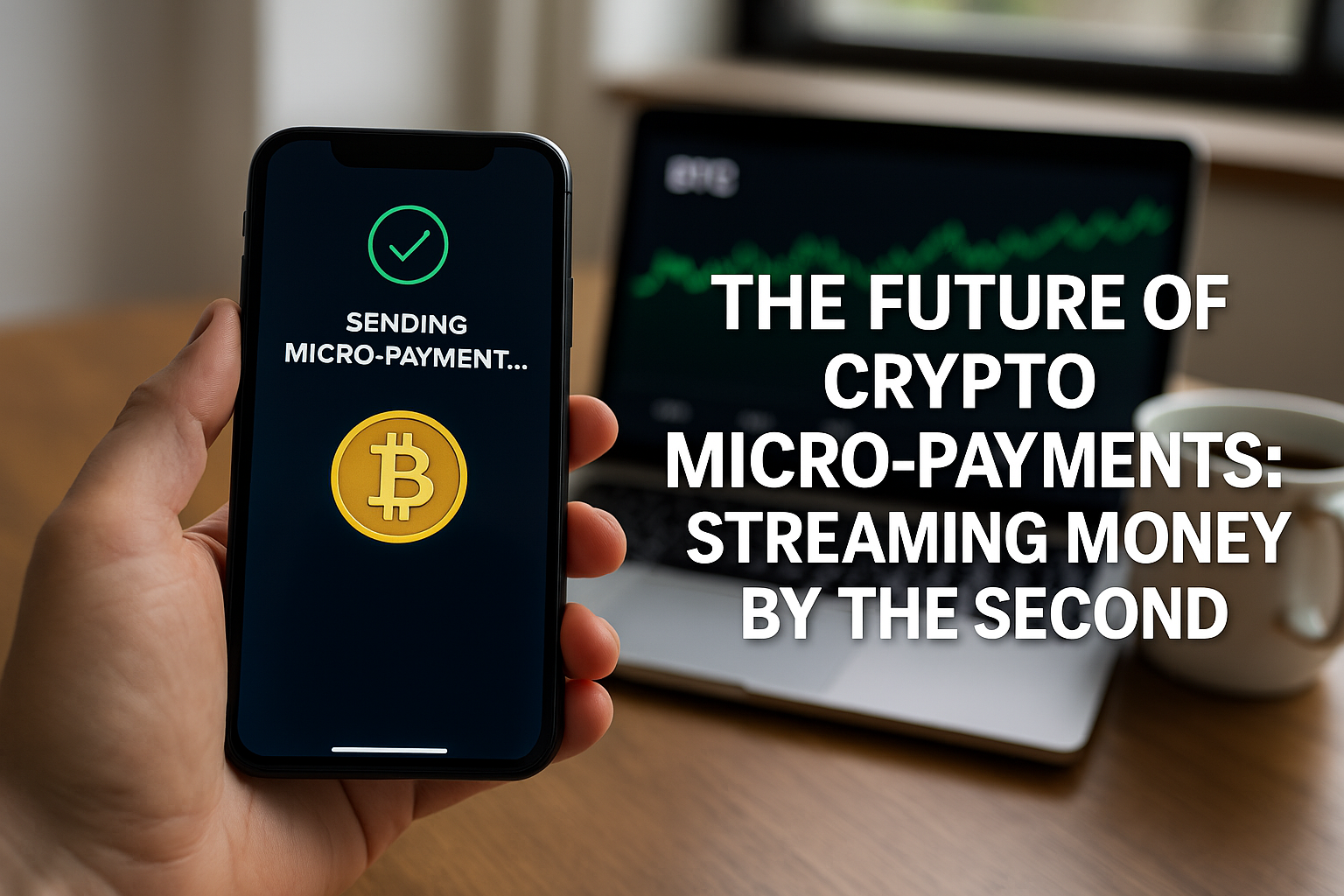
The Future of Crypto Micro-Payments: Streaming Money by the Second
 Payonramp|
In 2025, the way we move money is evolving faster than ever.
As the bitcoin price and other crypto assets surge, and as you track your BTC and bitcoin price USD daily, a quieter revolution is brewing: micro-payments — and even streaming payments by the second.
With players like XRP leading real-time transactions, crypto is making it possible to send fractions of a cent across the world instantly.
This opens up a completely new economy: think pay-per-second for content, per-minute streaming for music, or dynamic micro-loans!
Let’s explore the future of crypto micro-payments, how it’s being built today, and why it might redefine finance itself.
🔥 What Are Crypto Micro-Payments?
Micro-payments refer to tiny financial transactions — often fractions of a cent — that were traditionally too costly or inefficient using legacy systems.
Example Use Cases:
Paying $0.01 to read an article
Sending $0.005 for every second of music streamed
Tipping $0.0001 to a YouTuber per second of watch time
Crypto micro-payments remove middlemen (like banks, payment processors) and slash transaction fees, enabling real-world microeconomies.
🚀 How XRP and Bitcoin Enable Micro-Payments
Keyword: XRP
XRP, with its fast and low-cost blockchain (XRP Ledger), is ideal for micro-transactions.
Bitcoin (BTC), while secure and decentralized, faces challenges like high fees and slower transaction speeds — although Lightning Network is solving this.
Thus, the choice between XRP and Bitcoin for micro-payments depends on:
Speed
Cost
Network load
Infrastructure adoption
Bitcoin Lightning Network and Layer-2 solutions are making Bitcoin micro-transactions faster and cheaper.
📊 Bitcoin Price and Micro-Payments: The Challenge
Keyword: bitcoin price
A major factor affecting micro-payments is the Bitcoin price volatility.
Imagine trying to pay for a $0.01 article, but BTC fluctuates by 5% within minutes.
Thus, stablecoins (like USDC) or fast-settlement tokens (like XRP) are often preferred for stable micro-payments.
Bitcoin price USD tracking becomes essential for dynamic pricing models if Bitcoin is used directly.
💬 Why Bitcoin Struggles with Micro-Payments
People Also Ask: Why is Bitcoin impractical for micropayments?
Transaction Fees: Bitcoin's Layer-1 network fees can be higher than the payment amount itself.
Slow Settlement: Bitcoin blocks are mined roughly every 10 minutes.
Volatility: Price fluctuations can distort micro-payment values.
Energy Usage: Small, frequent transactions can increase blockchain congestion.
👉 Solution: Lightning Network, Sidechains, and Atomic Swaps aim to fix this.
🛠️ What Are Micropayments in Blockchain?
Keyword: micropayments in blockchain
Micropayments on blockchain allow users to:
Send small fractions of cryptocurrencies (e.g., 0.00001 BTC, 0.0001 XRP).
Pay per unit of consumption (e.g., per second, per byte, per click).
Enable real-time, programmatic payments without trusting centralized servers.
🔹 Blockchains like Ethereum (via Layer-2s), XRP Ledger, Solana, and Polygon are leading in micropayment implementations.
🔎 What is a Nano Payment?
People Also Ask: What is a nano payment?
Nano-payments are even smaller than micro-payments, often less than $0.001.
Typically used for hyper-granular transactions: e.g., paying $0.0000001 for every second you view a digital billboard.
Nano-payments wouldn’t be possible without crypto — traditional systems can't handle them efficiently.
🌍 Real-World Use Cases for Crypto Micro-Payments
Content Consumption
Pay per paragraph or second of a video.
Streaming Services
Pay per second/minute of music, podcasts, movies.
IoT Economy
Devices pay each other for data transfer (e.g., self-driving cars pay traffic sensors).
Dynamic Micro-Loans
Borrow $1 for 2 hours — repaid automatically by the second.
Gaming
In-game actions trigger nano-rewards and payments without centralization.
🛡️ Security Challenges for Streaming Payments
Fraud Prevention: How to verify thousands of transactions per second securely.
Privacy: Constant micropayments can leak behavioral data.
Compliance: Governments may regulate dynamic payments differently.
Solutions include zero-knowledge proofs, private payment channels, and smart contract auditing.
🔮 The Future: Streaming Money Non-Stop
Shortly:
Salaries could be streamed per second instead of monthly.
Content creators could earn live instead of waiting for platform payouts.
Microscopic loans, insurance premiums, and rent payments could self-adjust in real-time.
💬 Imagine Netflix charging you per second you watch — no fixed monthly subscriptions anymore.
📚 People Also Ask (Summary)
Why is Bitcoin impractical for micropayments?
Due to high transaction fees, slow confirmations, and volatility, though the Lightning Network is improving in this regard.
What are micropayments in blockchain?
Tiny transactions, often under $1, are processed efficiently via crypto without traditional payment processors.
What is a nano payment?
Extremely small payments (less than $0.001), made possible through blockchain microtransaction infrastructure.
⚠️ Disclaimer
This blog is for educational purposes only and should not be considered financial advice. Cryptocurrency and blockchain investments carry risks. Always do your own research (DYOR) and consult a financial advisor before making investment decisions.
🧠 Conclusion
Micro-payments powered by crypto are no longer science fiction — they’re here.
XRP, Bitcoin (via Lightning), Ethereum L2s, and newer blockchain projects are turning money into a flow, not a batch.
As bitcoin price USD fluctuations stabilize, and as more projects prioritize low-fee, instant transactions, expect micro and nano-payments to reshape:
How we consume content
How services are priced
How wealth is distributed
Get ready to stream your salary, rent, or even your internet bills — one second at a time.